
Spotlight on members of our community living with neuromuscular conditions: Jimmy Murray
Starting on Rare Disease Day on 29 February, over the coming months we’re going to share spotlights on individual members of our community who are living with a variety of neuromuscular conditions. We want to raise awareness about the many neuromuscular conditions experienced by diverse members of our community. The spotlights will then be added to a dedicated page on our website so that you can learn about people’s experiences of living with each condition.
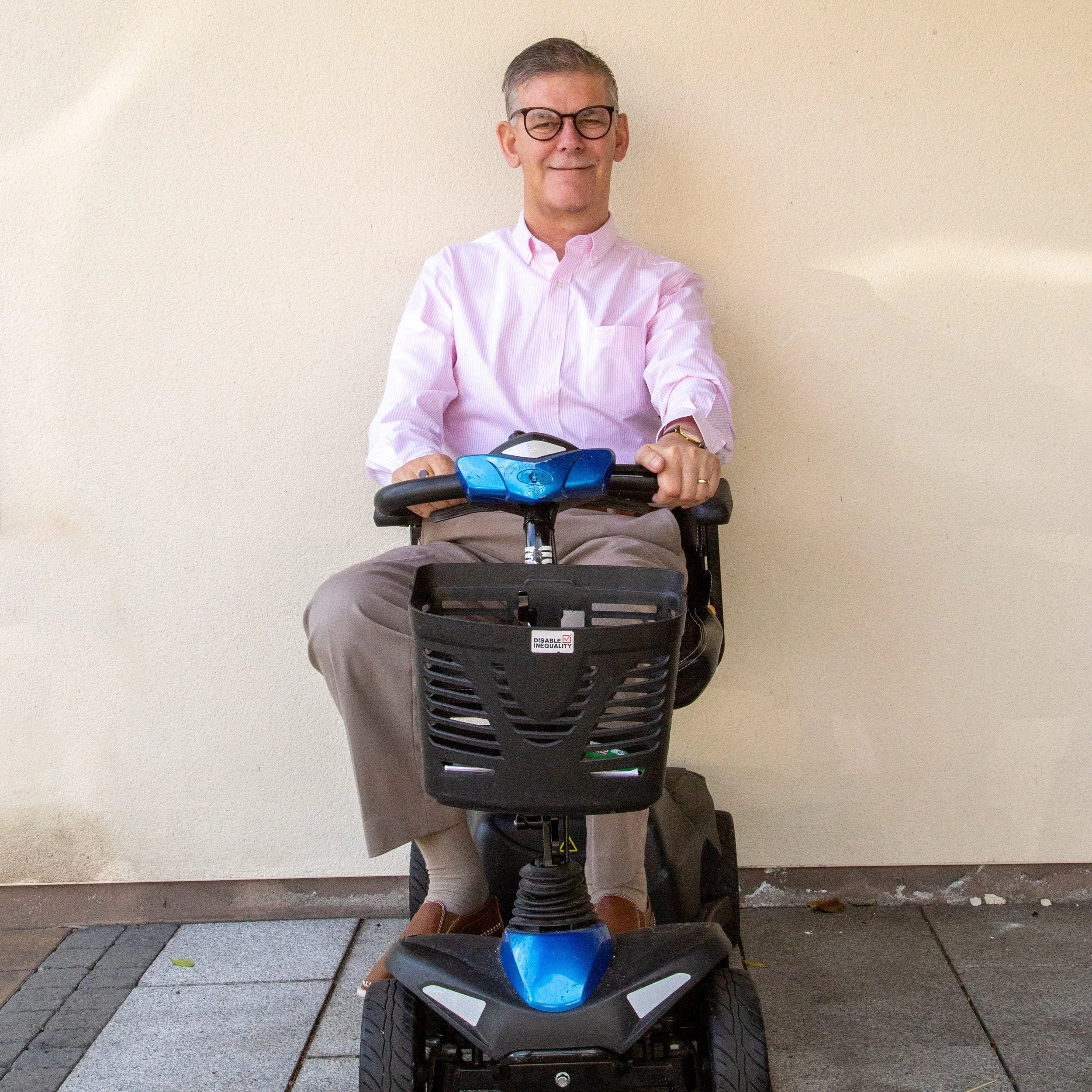
Jimmy Murray. [Photo by: Niall Dennehy]
Name:
Jimmy Murray
Age:
66
County:
Dublin
Type of neuromuscular condition:
Congenital myasthenia gravis, slow channel syndrome.
At what age were you diagnosed?
I was born with it. I didn’t get a definite diagnosis of congenital myasthenia gravis until I was 40 years of age.
What were your first symptoms?
As a child, I would always get tired and want to be lifted and I was unable to get off the floor independently to standing. This was a sign to my parents that something was amiss. They went to a neurologist in Harcourt Street who got testing done in Newcastle, UK. The original diagnosis was for an unspecified form of Duchenne muscular dystrophy. I had all the symptoms of someone with Duchenne. The prognosis at the time was that I wouldn’t survive my teens. However, I’m still here and defied the odds of the prognosis!
Do you have other family members who have the condition?
No. Where it came from is a mystery.
What do you find to be the greatest challenges living with your condition?
The greatest challenges are not physical. The biggest challenge has been convincing people, such as those in authority, that I had a role to play in life. So-called experts had me doomed that I had no life to live. That was my biggest barrier. I prefer to call it THIS ABILITY, which I possess, rather than disability.
Is there anything you’d like people not to assume about you because you have the condition?
I don’t like the words inspiration / inspiring. That’s not my role in life. My job is to live life and not be an inspiration to people, though they mean well. A lot of people with disabilities hate that.
What are your greatest accomplishments?
My own greatest accomplishment is living a normal life if there is such a thing for anyone. Every walk of life has challenges. I’m proud of what I’ve achieved. I’d proud of my family, my children and my wife. Rearing children through to adulthood with the support of my wife has been a huge accomplishment.
How has living with your condition influenced you into becoming the person you are today?
I have a lot of supporting mechanisms and empathy with other people with conditions and I love offering support and encouragement to people. I will always try and instil confidence in others to face barriers and not take it lying down. My disability is not an illness; it’s a challenge. When I need supports from agencies or the government, I don’t like being told I might be entitled to something. If it’s there, I have the right to have it to live my life.
Is there anything you’d like to say or offer as advice to a person recently diagnosed with the condition?
I stole this from a friend, Martin Naughton. He offered these words to parents whose child had just been diagnosed, ‘When it all settles down, there’s an awful lot of living to be done following diagnosis’. That’s my motto in life!
Is there anything you’d like the world to know about your condition?
Everything! Most people get myasthenia in mid-life, similar to motor neurone disease, multiple sclerosis and Parkinson’s. My condition was congenital which is very rare.
Muscular Dystrophy Ireland supports people living with myasthenia gravis. If you have any questions, you can contact us on our Information Line on +353 01 6236414 or on http://www.mdi.ie/contact.
You can find out more about myasthenia gravis here and here.
Disclaimer: The views expressed in the content are solely that of the interviewee and do not necessarily reflect the views of MDI. Furthermore, please note that while MDI shares information about neuromuscular conditions, we do not provide medical advice, diagnosis or treatment. This content is not intended to be a substitute for professional medical advice, diagnosis or treatment. Always seek the advice of your physician or other qualified health provider with any questions you may have regarding a medical condition.