
Get Involved In Research
There are many ways you can get involved in research, from filling out a survey to participating in a focus group, collaborating with researchers on the design of their study, or testing a new treatment. People living with neuromuscular conditions, their family, carers and healthy volunteers are all needed to help researchers understand the causes of these conditions, improve the diagnosis journey, and care pathways for individuals living with muscle weakening and wasting conditions.
Current Projects Recruiting
Help Improve Cancer Care for Individuals with Physical Disabilities
People with physical disabilities, such as those living with neuromuscular conditions, can face extra challenges when accessing cancer services.
Researchers at DCU are exploring the experiences of people who had a physical disability before their cancer diagnosis and are now living with or beyond cancer. Family members, daily support persons, and healthcare professionals involved in care are also invited to participate. The goal is to understand what supportive care is provided, what is needed, and how services can be improved.
Click here for more information about the study.
Contact details:
If you would like more information or wish to participate, please contact Noreena Coyle (PhD Research, School of Psychology, DCU).
Email: noreena.coyle2@mail.dcu.ie
Registries
What is a registry?
A registry is a collection of information about individuals, usually focused around a specific condition or group of conditions. Many registries collect information about people who have a specific condition. Individuals provide information about themselves to these registries on a voluntary basis or consent for their doctor or research assistant to gather information from their medical records for the purpose of the registry.
Why are registries needed?
Registries can provide health care professionals and researchers with first-hand information about people with certain conditions, both individually and as a group, and over time, registries can increase our understanding of that condition. Some registries collect information that can be used to track trends about the number of people with diseases, treatments, and more. Other registries invite people to sign up to be contacted about participating in clinical research. They may ask very basic questions about health history that would help determine whether someone is possibly eligible to join a research study.
What benefits will someone receive from participating in a registry?
Participation in a registry is likely to increase what we know about a specific condition, help health care professionals improve treatment, and allow researchers to design better studies on a particular condition, including development and testing of new treatments. Being part of a clinical trials registry can help people interested in participating in research connect with clinical investigators. However, individuals (and their families) who choose to participate in a registry should understand that participation will not guarantee a treatment or cure for their condition or that they will be eligible to join a study. Registries can be a critical resource to advancing clinical and public health research where no population-based registries exist and can be a valuable source of data for supporting regulatory decision-making, especially for rare conditions such as neuromuscular conditions.
Is there a registry available in Ireland for people with neuromuscular conditions?
Some countries have registries that are condition specific e.g. Duchenne muscular dystrophy registry or group specific e.g. neuromuscular disease registry. A key priority in MDI’s research strategy 2023 – 2025 is to develop a registry for people with neuromuscular conditions in Ireland. We will keep you updated as this develops. In the meantime, some international registries are available should people in Ireland want to enrol. These are listed on our MDI Registries page here.
Public and Patient Involvement
MDI is committed to putting its members at the heart of what it does. As part of our Research Strategy 2023-2025, MDI is committed to incorporating public and patient involvement (PPI) into its research activities. The inclusion of PPI contributors helps to ensure the unique insights of people with neuromuscular conditions are included in the planning of research, so it is meaningful to the community.
What is Public and Patient Involvement
“Doing research ‘with’ or ‘by’ members of the public rather than ‘to’, ‘about’, or ‘for’ them.” (INVOLVE )
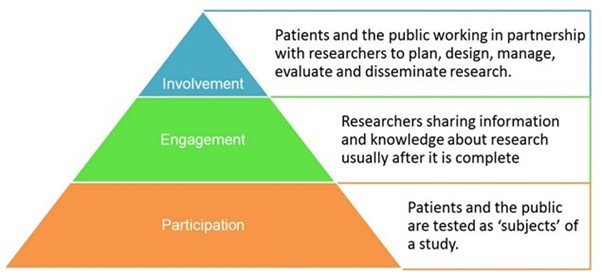
Patient Public Involvement otherwise known as PPI refers to people working in partnership with researchers to set research priorities, plan, design, manage, and evaluate research studies and may also include sharing the results or outcomes and suggesting how they can be implemented into practice.
It is a two-way relationship between researchers and members of the public offering advice, insights, and contributing to research projects in the same way other collaborators would.
The term Public includes patients, potential patients, carers and people who use health and social care services as well as people from organisations that represent people who use services. Whilst all of us are actual, or former users of health and social care services, there is an important distinction to be made between the perspectives of the public and the perspectives of people who have a professional role in health and social care services.
Examples of PPI include:
Working in partnership with a researcher to decide what research should be done and how it is done.
Been part of a project advisory or steering group.
Commenting and developing information leaflets or other research materials.
Reviewing grant applications.
PPI is Not!
Participating in a research project/clinical trial
Donating sample materials for research e.g. blood tests
Answering questionnaires
Who are PPI Contributors?
PPI may feel daunting however, contributors can be anyone with a connection to the topic or condition in question. PPI contributors wear many hats e.g. lived experience of a condition, parent, employee, student, brother/sister etc. People are bringing all their expertise to the table, not just their experience in the topic been researched.
Why is PPI important?
PPI is becoming increasingly common in all types of research. It can provide a real and substantial benefit to all stakeholders. While not without its challenges, PPI can:
Promote a sense of empowerment and value among people with lived experience of neuromuscular conditions.
Improve researchers’ insights into their own research area.
Help researchers identify barriers and come up with solutions to research.
Increase trust and acceptability of research findings in the neuromuscular community.
Click here to read how PPI made a difference in one researcher’s project.
PPI at MDI
As part of our research strategy 2023 – 2025 MDI are establishing a PPI advisory network. The purpose of the PPI advisory network is to support meaningful PPI in research as best practice. These include:
Contributing to the Planning and Development of Research Projects: Researchers approach MDI to seek input from PPI contributors in the planning and development of their research project.
Reviewing Research Activities and Grant Applications: MDI invites PPI contributors to review research activities led by the organisation or evaluate grant applications received from researchers. Your feedback ensures that research is aligned with the priorities of those it aims to serve.
What is involved?
As a PPI contributor, your primary role is to provide your unique perspective on a research project. The level of involvement and time commitment required will vary depending on the specific activity. For example, more in-depth involvement may be needed if PPI is included from the very beginning of a study, such as helping decide on the research focus, compared to reviewing a patient information sheet or consent form that outlines the research being conducted.
You will typically be asked to offer insights based on your own experiences. While your input should be rooted in your personal experience, please note that PPI is not a platform for discussing your own medical treatment. The goal is to help researchers better understand their work from the perspective of someone directly affected by the research topic.
As a PPI contributor, you will be expected to attend and actively participate in meetings. These meetings will generally be held online, but if in-person meetings are scheduled, we will discuss this option with the group. The frequency of meetings may vary depending on the research study, with some being one-off sessions and others spanning a series of meetings. We understand that personal circumstances can impact your ability to contribute, and we are committed to making accommodations where possible to support your involvement.
What our PPI Contributors have to say
We are proud to share some feedback from those who have engaged in PPI activities with us. Their feedback highlights the impact of collaboration between researchers and the people who are directly affected by the research.
Although this was all new to me, I was given clear guidance on what was expected, and I felt comfortable contributing to the conversations and sharing my experiences and opinions freely. I will encourage others to get involved, especially when there’s a piece of work at the end that hours of thought and consideration have gone into. – Caroline Cahill
I am grateful for the invitation to be involved and for the positive impact it will no doubt have on the lives of people living with muscular dystrophy. I was able to share my personal experiences and opinions freely. My advice to others is - go for it ! – Grace Walsh
I felt that we were listened to and that the researcher understood as well. Zoom was great, as it allowed me to have a voice regardless of my location. You will get more out of it than you put in. We need more people to take an interest in rare diseases. – Marion Peoples
What to do next
If you’re interested in participating in PPI research activities, we would love to hear from you! We welcome individuals who are living with a neuromuscular condition, as well as parents, family members, and carers of those affected. Your unique perspectives and experiences are invaluable in shaping research and supporting the neuromuscular community.
To express your interest or learn more, please contact Dympna Mulroy, MDI Research Officer, at mdiresearch@mdi.ie