
Disability Federation of Ireland: Devastating Sidelining Of Disabled People
Budget 2024 offered an opportunity for the government to show its commitment to the one in five people across Ireland who have a disability, on the five-year anniversary of the ratification of the UN CRPD. DFI had called for a range of interwoven measures in Budget 2024 to ensure disabled people have equal opportunity to live independently in the community, with choices equal to others (Article 19, UN CRPD). Appropriate housing, adequate income and individualised social care supports (with access to timely integrated healthcare) are key areas that require investment.
Unfortunately, Budget 2024 did not deliver. Instead, it seemed to give something to everyone, but not nearly enough to those who need it most. The government could have chosen to invest in disabled people, tackling exclusion and poverty. It did not, instead leaving many disabled people facing an income cliff edge in 2024 and an ongoing lack of the services and supports necessary for independent living and community inclusion.
Below DFI provides our analysis of Budget 2024 in the four core areas that were the focus of our pre-budget submission.
1. Sustainable Disability Health and Social Care Services (Department of Children, Equality, Disability, Integration and Youth and Department of Health)
Budget day again saw a lack of clarity regarding the allocation for disability services. DFI sought immediate clarification and can confirm that Budget 2024 provided €64.1m additional funding for disability services, and €131m for Existing Level of Service funding, including the full year cost of Budget 2023 measures - that is the cost in 2024 of ongoing measures announced in 2023.
Government approved the Disability Capacity Review Action Plan in July and the Department of Children, Equality, Disability Integration and Youth (DCEDIY) announced that the Action Plan would be published in early autumn. However, we still await its publication – it is now more than two years late. Without the prior publication of the Disability Capacity Review Action Plan appropriate scrutiny of Budget funding is not possible. It is nevertheless clear that the additional funding allocated in Budget 2024 for implementation of the Action Plan falls far below the requirements documented in the Disability Capacity Review to address demographic change and significant unmet need.
The €64.1m additional funding announced breaks down as follows:
€20.5m for 90 to 100 residential places for children and adults
€10m for respite services to build on existing provision, and to provide more alternative respite such as in homes, after-school
€18.2m for school leavers entering day services – 1,250 to 1,400 places
€2m additional funding for Personal Assistant services, delivering around 80,000 additional hours and for continued investment in Home Support services
€1.4m for increased investment in community neurological teams
€8.5m for children’s services, including the recruitment of additional therapy positions, increasing third level places and supports for specialist children’s disability services
Within this budget provision, the low level of funding allocated for PA services is a particular concern, in spite of ESRI research this year highlighting inadequate levels of PA services and underfunding. The lack of increased provision to support people aged under 65 inappropriately placed in nursing homes to move to more appropriate settings is also disappointing. Funding is also needed for day services under New Directions to address unmet need among older adults, for those beyond the yearly cohort of school leavers.
Significant recruitment and retention challenges in Section 39 funded organisations were highlighted strongly in advance of the Budget, and an impending strike in Section 39 disability services was averted at 3am on Tuesday 17th October, the day the strike was due to begin. Read DFI’s commentary on this here.
Linked to the above, DFI is disappointed that there is a lack of clarity in relation to funding for voluntary disability organisations to address significant ongoing inflationary pressures.
The insufficient funding for disability services takes place in the context of a low level of Budgetary funding for the health service as a whole. This
This would equate, according to our rough calculations based on these figures, to one additional hour per week for 1,538 people or 10 additional hours per week for 154 people.
Eamonn Carroll, Ciarán Mac Domhnaill and Selina McCoy, “Personal Assistance Services for Disabled People in Ireland: ‘they meet the criteria for supports but we don’t have the resources to provide the services’,” Economic and Social Review, Vol. 54, No.3 (Autumn 2023)
has been widely commented on by HSE and government figures, and in the media.[1]
A significantly higher level of transparency is needed about how government decisions are made on disability funding. Greater transparency was hoped for with the transfer of department functions for community specialist disability supports from the Department of Health to DCEDIY in March.
Disability organisations, who deliver upwards of 70% of disability services in Ireland, do not have a formal channel for engaging with the Department of Public Expenditure and Reform to outline evidence of funding needs and engage collaboratively. It is essential that people with disabilities and disability organisations are a part of decision making on funding.
In addition to the €64.1m additional funding in Budget 2024 for disability services outlined above, €131m was allocated for Existing Level of Service, including the full year cost in 2024 of Budget 2023 measures. Capital investment of €23.7m will provide for the upgrading and development of disability services.
The following was also announced for mainstream health services:
· €500m to tackle waiting lists including opening and staffing six new surgical hubs
· €2.3m increased funding for Healthy Ireland Programme
· €10m to support private and voluntary nursing homes with HIQA regulation and compliance measures
· €3.7m for Day Services for Older Persons and Meals on Wheels
· €300,000 for weekend activity clubs for people with young onset dementia
· €1.2m to establish a commission on care for older persons
· €4.6m for transitional care funding to support older persons leaving hospital
· €13-14m for new measures in mental health services, including 68 new posts for Child and Adolescent Mental Health Services (CAMHS)
2. Tackling High Poverty Levels and the Cost of Disability (Department of Social Protection)
Budget 2024 did not take the opportunity to finally start to tackle the extremely high poverty levels of disabled people. Unfortunately, the €12 increase in Disability Allowance and other weekly social protection payments was less than half the amount needed to avoid a real term cut in people’s spending power in 2024. DFI and other anti-poverty organisations had called for a €27.50 weekly increase just to keep pace with inflation.
The Vincentian MESL Research Centre, analysing Budget 2024, concluded that “the purchasing power of core social protection supports has not been maintained, as a result the adjustments are a real term cut. […] These measures are likely to compound the deepening and widening of income inadequacy that developed this year”.
A weekly Disability Allowance payment of €232 in 2024 will be €86/27% below the updated poverty line, as estimated by Social Justice Ireland. And this is before considering the many extra costs that disabled people live with, which are in the range of €8,700 - €12,300 a year (Indecon Cost of Disability report).
For decades, DFI has called for a weekly Cost of Disability payment, as an interim measure to start to address this. While Budget 2023 for the first time acknowledged the extra Cost of Disability, disappointingly there was no acknowledgement in the Budget 2024 speeches. Moreover, the Budget 2024 one-off lump sum for those who rely on Disability payments to survive was set at €400. This is a 20% reduction on last year, despite the extra Cost of Disability actually having increased since Indecon's report, due to significant and ongoing inflation.
As DFI said last year, disability is not a one-off, and while the temporary supports are welcome, they provide no income security or predictability to disabled people. The ESRI’s Budget Analysis shows that disabled people will remain the group most at risk of poverty in 2024, and that there will actually be a small increase in the ‘at risk of poverty’ rate for people with disabilities next year. It also shows that the gains for disabled people in Budget 2024 are only due to the temporary one-off measures, while there are less gains for those with a disability from permanent tax and welfare changes as compared to those who are not disabled. This is alarming given the much higher poverty rates of people with disabilities.
Most of these one-off payments will be paid in 2023, leaving disabled people with a significant income gap once again in 2024. The three electricity credits will provide some relief for disabled people who face high energy bills. But the use of a universal credit rather than a targeted credit focusing on those who need it the most for the second year is not the most efficient use of state resources.
Key measures as outlined in Budget 2024:
· €12 increase of weekly disability payments, and proportionate increases for people getting a reduced rate
· €400 cost of living lump sum for those receiving Disability payments or Carer’s Support Grant in November
· €300 cost of living lump sum for those who receive the Fuel Allowance in November
· €200 cost of living lump sum for people who receive a Living Alone allowance in November
· Cost of living double payment to be paid in January 2024
· Provision for Free Travel Scheme for people medically certified unfit to drive (DFI member Epilepsy Ireland ask achieved)
· Reduce the minimum weekly hours threshold from 21 to 15 hours for the Wage Subsidy Scheme (an ask of many organisations, including DFI member Rehab - who asked for the threshold to reduce to 8 hours)
· Increase in the Carer's Allowance income disregard to €450 for a single person and €900 for a couple
· 3 x €150 electricity credits (via Department of Environment, Climate and Communications) to be paid in December, January, and March.
See https://www.rte.ie/radio/radio1/clips/22309127/, https://www.irishtimes.com/health/2023/10/12/stephen-donnelly-admits-to-shortfall-in-health-budget-for-next-year/, https://www.thejournal.ie/mental-health-services-mary-butler-6193667-Oct2023/,
Case Study
The Department of Social Protection has released a set of case studies of the impact of Budget 2024. One case study looks at ‘Jim’, who is 28, disabled and lives alone.
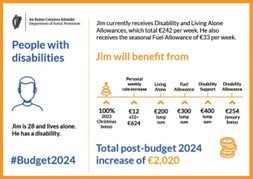
Of the total increase of €2,020 the Department shows, more than half of this will be paid to Jim in the 2.5 months until the end of 2023 than in the 12 months of 2024. From October to December 2023, Jim will receive €1,142 in one-off payments. Over the course of 2024, Jim will receive a total of €878 from the €12 weekly Disability Allowance increase and the January double payment. This means that Jim faces an income drop in 2024, when his income will remain below the poverty line and will not have kept up with inflation over the past number of years.
3. Ensuring Community Inclusion and Participation (Multiple Departments)
Disabled people have the right to live independently and participate in their community equal to others. Delivering these rights requires sufficient supports, coordination and collaboration of local agencies, and action by all Local Authorities. DFI had thus called for a new ‘disability inclusion fund’ to provide funding to all Local Authorities to support their delivery of their UN Convention on the Rights of Persons with Disabilities (UN CRPD) and Public Sector Duty responsibilities. We had also advocated for increased investment in Local Link, the establishment of the long-awaited Transport Support Scheme, and funding of €2 million for assistive technology supports.
No detailed information or breakdown of the overall non-HSE disability budget allocation indicated by the Department of Children, Equality, Disability, Integration and Youth (DCEDIY) was provided, making it hard for us to analyse what was and wasn’t included in Budget 2024. The DCEDIY said that “the allocation for 2024 will also drive a broader programme of work in Disability Equality Policy”, and highlighted the following areas:
· A dedicated budget will support the implementation of the United Nations Convention on the Rights of Persons with Disabilities (UNCPRD)
· An ambitious new National Disability Strategy and the Autism Innovation Strategy
· Funding to support important initiatives under the Disability Participation and Awareness Fund, including ring-fenced support for Disabled Persons Organisations, and employment supports for persons with disabilities through the Towards Work and Employers for Change Initiatives, as well as enhanced stakeholder engagement
Disappointingly, no allocation was announced in Budget 2024 for a local authority disability fund under DCEDIY, the Department of Housing, Local Government and Heritage or the Department of Rural and Community Development. Nor was any additional funding announced for Local Link, for the long-awaited Transport Support Scheme, or for assistive technology.
4. Realising Housing for All (Department of Housing)
Housing was described in Minister Michael McGrath’s speech as the “biggest domestic challenge” and “top priority for the government.” The additional housing needs of disabled people, which are a crisis within the wider housing crisis, are well documented. However, it is not fully clear which aspects of the Housing for All budget relate specifically to disability. This is another example of the unfortunate trend, as outlined above, of the Budget lacking clarity and transparency in relation to disability provisions.
Notwithstanding this, DFI were pleased to see increases in the Housing Adaptation Grant and Capital Assistance Scheme funding to support adaptation and construction of housing for people with disabilities - although these were not increased to the level DFI had sought. It was positive to see the increase to the Housing Adaptation Grant funding quadruple from an additional €2m last year to an increase of €8m this year. However critical reform elements including increases to the maximum grant amount and a change to the means testing process to take account of Cost of Disability have not yet been addressed. DFI advocated for this in its 2022 submission to the review of the Housing Adaptation Grants by the Department of Housing, Local Government and Heritage, the outcome of which is still awaited.
In future years, a specific funding line linked to the Housing Strategy for Disabled People 2022-2027 should be included in the Budget, with a breakdown of the funding allocated for various themes and aspects of disability housing. There is a long way to go until we see the housing needs of disabled people being built into mainstream planning and funding.
Key Measures as outlined in Budget 2024:
· €8m additional funding for Housing Adaptation Grants for people with disabilities and older persons (bringing total funding to €75m)
· €3m additional funding for the Capital Assistance Scheme which supports construction of housing for priority groups, including people with disabilities (bringing total funding to €140m)
· €75m additional funding under the Social Housing Current Expenditure Programme to support the delivery of over 6,000 additional social housing homes.
· €27m additional funding for homelessness services
· The Rent Tax Credit (for tenants in private rental accommodation only) increased from €500 to €750 per annum.
· Help to Buy Scheme for first time buyers amended to allow applicants using the Local Authority Affordable Purchase Scheme to buy their home to qualify.
A Clear and Transparent Budget
Budget 2024 has again highlighted the need for transparency about the details and decision-making on funding for disability, including disability services.
Many of the details behind the high-level funding figures for disability services will not be available until publication of the HSE’s National Service Plan, which last year was not published until the end of March. It is not acceptable that people with disabilities, their families and disability organisations, including those who deliver essential services, must wait six months to fully understand the details behind the disability services Budget. In addition, ongoing delays with the publication of the Disability Capacity Review Action Plan continue to significantly inhibit appropriate scrutiny of the Budget.
Alongside colleagues in the sector and from the Oireachtas Disability Group we have called for significantly greater levels of transparency, both in terms of the detail behind Budgetary announcements, which should be clear and accessible, and regarding how government decisions are made on disability funding.
The UN CRPD requires all government Departments to work to realise the rights of people with disabilities. It is disappointing that across many government Departments, such as Housing, Local Government and Heritage; Rural and Community Development; Transport and others it is unclear which funding lines and level of funding relate to disability. Information on budget provisions, clearly disaggregated for disability across all government Departments, is required on Budget Day.
For more information, and to see the responses to Budget 2024 of DFI members, see their Budget 2024 webpage